
| On This Page Pillar 1: Order Execution Done Right Pillar 2: Real-Time Market Data Pillar 3: Portfolio Tracking That Stays Accurate The Architecture That Ties It Together Compliance and Security by Region Tech Stack, Cost, and Timeline Real Case Study: Tradvysor by Acquaint Softtech FAQs |
Why Most Trading Apps Break Under Real Load. Most stock trading apps look fine in a demo and fall apart the day real users and real markets show up. The demo shows a clean chart and a working buy button. What it hides is the hard part: prices that must update in milliseconds, orders that must execute exactly once and never twice, and a portfolio that must reconcile to the cent even when an exchange feed hiccups.
Building a trading app well is mostly about getting those three things right. Acquaint Softtech’s software product development services build trading and investment platforms for clients across the USA, UK, Europe, UAE, and India.
Here is where it bites. The biggest mistake founders make is assuming a brokerage API solves the hard parts; it helps with execution, but it does not remove the need for KYC, market-data licensing, audit logs, security testing, and clean failure handling when markets move fast or a third party goes down. A price feed that lags by two seconds shows users a stale number, and they trade on it.
An order that double-fires costs real money and trust. A portfolio that drifts out of sync turns into support tickets and churn. These failures are expensive precisely because they involve money and regulation, the two areas where users are least forgiving.
The fix is to treat the app as three connected systems: order execution, market data, and portfolio tracking, each engineered for correctness and speed, sitting on an architecture built for real-time load. That is exactly how the rest of this guide is organized. For teams who want a partner who has shipped this before, the practical step is to hire dedicated developers with trading-platform experience, and the framework decision behind such a build is compared in this guide on Laravel vs MERN stack for startups.
Pillar 1: Order Execution Done Right
Order execution is the feature users trust with their money, so it must be reliable, fast, and fully auditable. At its core, the app sends a user’s buy or sell instruction through a brokerage API or partnering broker, which routes it to the exchange and returns a fill. The engineering challenge is everything around that: validating the order, handling partial fills, preventing duplicates, and logging every step for compliance. Acquaint Softtech’s MERN stack developers build the order-management system (OMS) that makes execution dependable.
Best execution is not a slogan; it is built. A solid OMS uses smart order routing, real-time validation against the user’s balance and limits, and an immutable audit trail so every order can be traced end to end. It must handle order types (market, limit, stop), reflect status changes instantly, and fail safely when a broker or exchange is unreachable, queueing or rejecting cleanly rather than guessing.
This correctness-first design is core software product engineering services. Using a brokerage API such as the well-known retail trading APIs does reduce how much you build, but you still own the integration, the idempotency, and the reconciliation.
Pillar 2: Real-Time Market Data
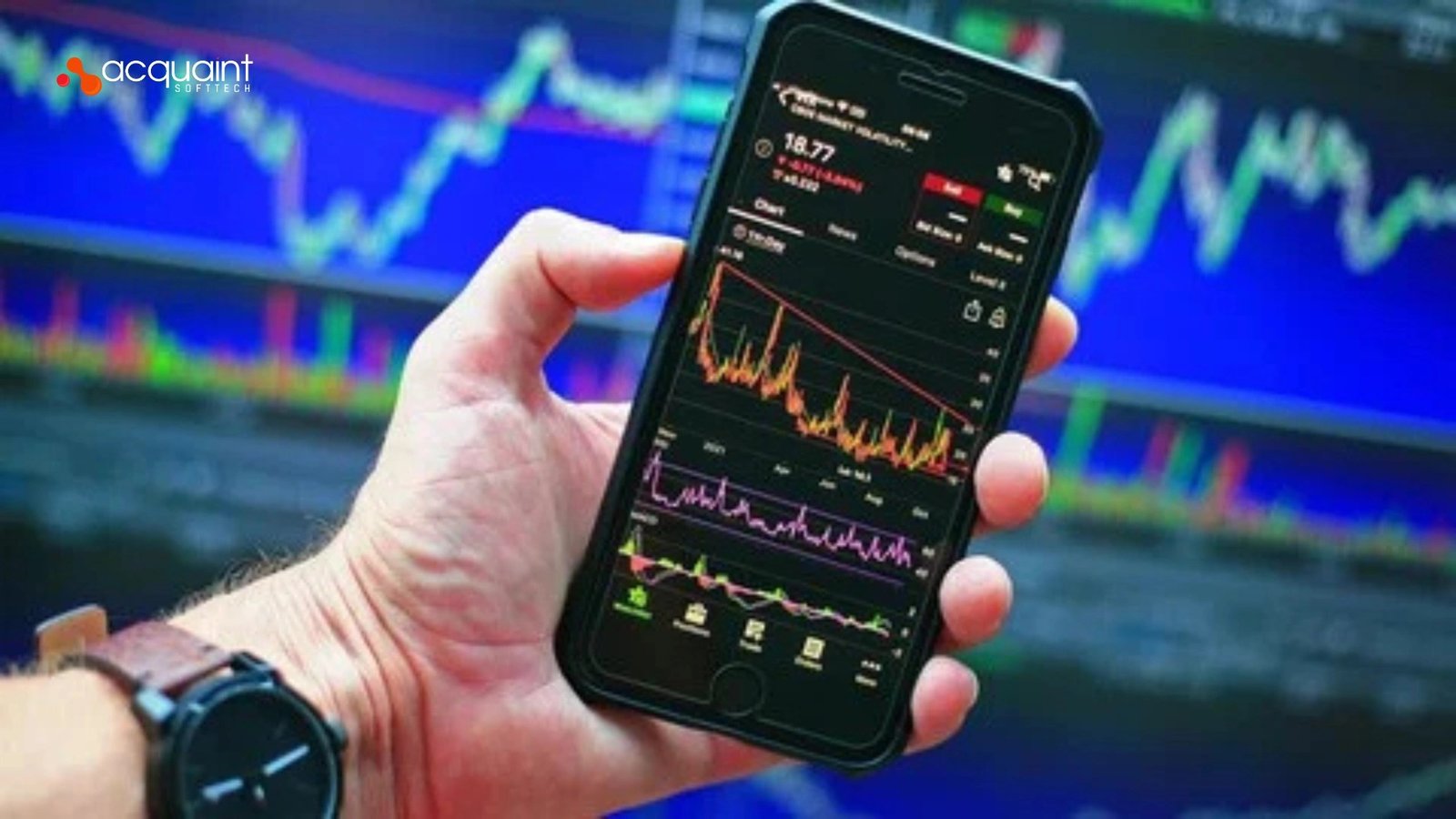
Real-time market data is the heartbeat of a trading app, and it is harder and more expensive than most teams expect. Users need live quotes, charts, and order-book depth that update sub-second, because a stale price is a wrong price they may trade on. This is delivered with streaming connections, typically WebSockets, from a market-data provider or directly from exchange feeds, with a caching layer so thousands of users can watch the same symbol without hammering the source. Acquaint Softtech’s MEAN stack developers build the data service and the streaming layer that feeds the UI.
Two realities shape this pillar. First, market-data licensing is a real cost and a legal requirement: exchange and feed fees are a significant part of a trading platform’s budget, not an afterthought. Second, the feed’s architecture matters as much as its speed, redundancy, failover, and an SLA decide whether your prices stay live when one node fails. Designing for that resilience is a specialized product engineering services task.
For history and analytics, raw ticks go into a time-series store, so charts and indicators load fast, while live prices sit in a fast cache. The data-pipeline patterns behind this are explained in this complete MERN stack development guide.
| Data Need | How to Serve It | Why |
| Live quotes | WebSocket stream + cache | Sub-second updates |
| Charts/history | Time-series database | Fast historical loads |
| Order book depth | Streaming feed handler | Real-time accuracy |
| Reliability | Redundancy + failover | Prices stay live |
Pillar 3: Portfolio Tracking That Stays Accurate
Portfolio tracking is what users open the app to see, so it must be accurate to the cent and update the moment anything changes. It shows holdings, current value, profit and loss, and allocation across the user’s positions, recalculated as prices move and as orders fill. The hard part is reconciliation: the portfolio must always agree with executed orders and live prices, even when a feed lags or an order partially fills. Acquaint Softtech’s Laravel developers build the position-keeping and profit-and-loss logic that keeps the numbers honest.
Good portfolio tracking layers in features users now expect: a watchlist of symbols they follow, unified views across asset classes, performance over time, and clear gain-loss breakdowns. Feature depth here correlates directly with how long users stay, so it is a retention lever, not just a display. Building it as a real-time, event-driven view rather than a nightly batch is what makes it feel trustworthy, a core software development capability.
A useful early feature is paper trading, a simulated portfolio that lets users practise without real money and lets you test the tracking engine under realistic conditions before real funds are involved. The MVP-first sequencing that adds these layers cleanly is documented in this story on how a startup saved $60K a year on remote hiring, published on acquaintsoft.com.
The Architecture That Ties It Together
The three pillars only work if the architecture underneath them is built for real-time load, which is why microservices beat a monolith for a serious trading app. The standard shape is a client (mobile and web) talking to an API gateway, which fronts separate services: an order-management service, a market-data service, a user-account service, and a compliance and risk engine.
Each scales independently, so a spike in price-feed traffic does not slow down order execution. Acquaint Softtech’s stack developers, through their White-label software development services, design and build this service topology.
The data layer is where trading apps differ most from ordinary apps. A common, proven setup uses PostgreSQL for transactional data like orders and accounts, Redis for caching live prices, and a time-series database for historical market data, deployed on a major cloud with container orchestration for scaling. A monolith is fine for an early MVP, but real-time trading under load rewards the microservices split. Getting this foundation right is core software product engineering. The deployment and scaling patterns behind a real-time platform like this are detailed in this MERN stack app deployment guide.
Compliance and Security by Region
Trading apps are regulated financial products, so compliance and security are build requirements from day one, not a final checklist. The non-negotiables everywhere are KYC and AML onboarding, encryption, secure access control, immutable audit logs, and two-factor authentication. What changes by market is the regulator and the specific rules. Acquaint Softtech’s DevOps and security engineers build this security and compliance layer into every flow.
- USA: SEC and FINRA govern securities trading, with strict best-execution, disclosure, and record-keeping rules.
- UK: the FCA regulates trading platforms, with conduct, suitability, and Consumer Duty obligations.
- Europe: MiFID II sets investor-protection, transparency, and best-execution requirements across the EU.
- UAE: the SCA and the DIFC and ADGM free-zone regulators oversee trading and investment platforms.
- India: SEBI regulates securities, with exchange rules from the NSE and BSE and strong KYC norms.
The practical move is to map your target market’s regulator during discovery and design the audit trail and KYC flow to match, because retrofitting compliance after launch is slow and costly. The Tradvisor build, for instance, integrated real Indian exchange feeds (MCX, NCDEX, NSE) where SEBI and exchange rules apply. Mapping this correctly is where software development outsourcing to a compliance-aware partner pays off, and the discipline behind it is covered in this overview of Acquaint Softtech’s Clutch recognition.
Read Also: Automotive Fog Light Bulbs: How to Choose the Right Upgrade for Your Vehicle
Tech Stack, Cost, and Timeline
The proven stack for a trading app pairs a real-time front end with a service-based backend and a multi-store data layer. React, or Next.js for web and React Native or Flutter for mobile handle the UI, with WebSocket connections for live prices; Node.js or Python power the API and services; and PostgreSQL, Redis, and a time-series database cover transactional, cache, and historical data.
On cost and time, an MVP covering onboarding, live data, order execution, and portfolio tracking typically takes 4 to 8 months, while a full-scale platform runs a year or more; budgets commonly start around $40,000 and rise with feature depth, market-data licensing, and compliance scope. India-based teams deliver the same quality at up to 40% lower cost; the saving is documented in this story on how a startup saved $60K a year on remote hiring. The smart path is to launch a focused MVP, prove the three pillars on real data, then add research tools, social features, and more asset classes.
| Layer | Recommended Tech | Role |
| Front end | React / React Native | UI, live charts (WebSocket) |
| Backend | Node.js or Python | OMS, data, account services |
| Data | PostgreSQL + Redis + TSDB | Orders, cache, history |
| Infra | Cloud + containers | Scale under real-time load |
Real Case Study: Tradvysor by Acquaint Softtech
Acquaint Softtech built Tradvysor, a real, cross-platform stock-exchange forecasting application, which makes it a concrete proof point rather than a hypothetical. The client wanted a clean, minimalist product that delivered live market data and forecasting across multiple Indian exchanges, and the team delivered it as a robust, cross-platform app. This is documented publicly in Acquaint Softtech’s stock trading application development case study.
What Acquaint Softtech built
- Real exchange feeds: live market data from Metal & Energy (MCX), the National Commodity & Derivatives Exchange (NCDEX), the National Stock Exchange of India (NSE), and currencies.
- Cross-platform app: one product working across platforms, with a deliberately minimalist design the client preferred.
- Secure payments and support: a secure payment gateway, smart notifications, and live support built in.
- Tech stack: Kotlin, JavaScript, WordPress, and Laravel, combined to deliver a robust, scalable platform.
The lesson from Tradvisor maps exactly onto this guide: the value was in delivering real, multi-exchange market data reliably inside a clean cross-platform app; the market-data and experience pillars done right. For teams planning something similar, the same approach applies, and the broader engineering track record is summarized in this overview of the best software product engineering companies in 2026.
FAQs
How much does a stock trading app cost to build?
An MVP typically starts around $40,000, and a full platform runs higher, driven by features, market-data licensing, and compliance. India-based teams cut costs by up to 40%.
How long does stock trading app development take?
Roughly 4 to 8 months for an MVP, and a year or more for a full-scale platform, depending on data integrations, compliance, and feature depth.
What features does a stock trading app need?
Core features are KYC onboarding, real-time market data, order placement and execution, portfolio and watchlist tracking, secure payments, 2FA security, and audit logs.
What is the best tech stack for a stock trading app?
React or React Native on the front end with WebSockets, Node.js or Python services, and PostgreSQL plus Redis plus a time-series database, on the cloud with containers.
Do I need a brokerage API or my own license?
Most apps integrate a brokerage API for execution rather than holding their own license, but you still handle KYC, market-data licensing, audit logs, and reconciliation.
How is real-time market data delivered?
Through streaming WebSocket feeds from a data provider or exchange, with a cache for live prices and a time-series store for history, plus redundancy for reliability.